dele alle tradizioni artistiche, culturali e religiose ma anche con
gli occhi ben aperti sulla realtà del ventunesimo secolo. Ma è
Mada’in Saleh che meglio rappresenta la storia della penisola
quando era attraversata dalla via carovaniera dell’incenso.
Difcile descrivere la bellezza e l’unicità di quest’area sel-
vaggia, spettacolare, sconosciuta ma così ricca di interesse ar-
cheologico. Mada’in Saleh (la città del profeta Saleh) è il nome
attuale dell’antica Hegra la città nabatea che, assieme a Pe-
tra in Giordania, erano i due centri più importanti sulla rotta
dell’incenso, la via carovaniera che proveniva dal regno della
regina di Saba (l’attuale Yemen) e attraverso tutta la penisola
arabica portava le merci che venivano prodotte tra i monti del
sud o che erano importati dall’India fno al Mediterraneo. I Na-
batei erano degli straordinari scultori di rocce e, come a Petra,
a Hegra hanno scolpito un centinaio di enormi tombe su pare-
ti rocciose e roccioni isolati nel deserto la maggior parte del-
le quali decorate con ingressi maestosi arricchiti da colonne,
capitelli, architravi, aquile e altri simboli che risaltano in modo
sorprendente sulla roccia giallo ocra di queste montagne. Gli
interni sono vuoti, depredati da secoli di razzie e presentano
solamente nicchie e loculi dove venivano posti i corpi dei mor-
ti. La città raggiunse il suo massimo splendore tra il I sec. a.C. e
Riyadh is the symbol of contemporary Arabia. Loyal to artistic,
cultural and religious traditions but also with its eyes wide open
to the reality of the 21st century. Ma è Mada’in Saleh che meglio
rappresenta la storia della penisola quando era attraversata dal-
la via carovaniera dell’incenso.
It is difcult to describe the beauty and uniqueness of this
wild, spectacular and unknown area, an area, nonetheless,
extremely rich in archeological interest. Mada’in Saleh (the city of
the prophet Saleh) is the present name of the ancient Hegra, the
Nabatean city which, along with Petra in Jordan, were the two
most important centres along the incense road, the caravan route
that came from the kingdom of the Queen of Sheba (present-day
Yemen) and, crossing the entire Arabian peninsula, facilitated the
transportation of goods produced among the mountains of the
south or that were imported from India to the Mediterranean.
The Nabateans were extraordinary rock sculptors, and, as in
Petra, in Hegra they sculpted hundreds of enormous tombs on
stone walls and huge rocks isolated in the desert, most of which
were decorated with majestic entrances enhanced with columns,
capitals, beams, eagles and other symbols that stand out in a
surprising way on the ochre-yellow rock of these mountains. The
interiors are empty, despoiled after centuries of raids, but usually
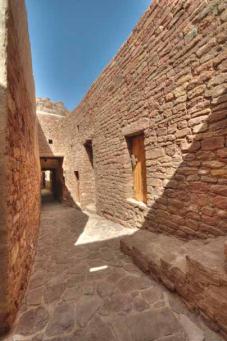
Un passaggio a Al Ula.
A narrow street in Al Ula.
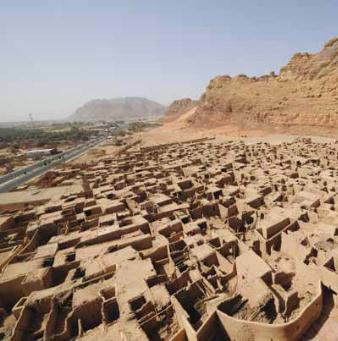
Veduta della cittadina di Al Ula. |
View of the little town of Al Ula.
129
Resorts Magazine
>>
Spring 2010