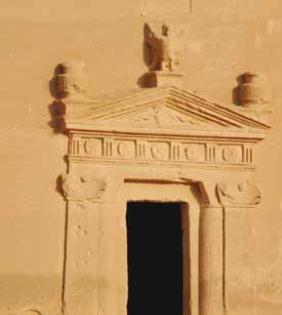
SOPRA: Un portale decorato con vasi e aquila.
ABOVE: A portal decorated with vases and eagle.
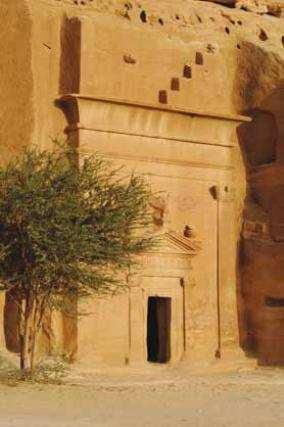
A SINISTRA: Una delle tombe più grandi.
ON THE LEFT:One of the largest tombs.
L
a storia della penisola arabica è antica e complessa. Si-
curamente più di quello che comunemente si immagi-
na. Ma il Paese oggi stupisce il viaggiatore anche con le
meraviglie tecnologiche e modernissime torri.
L’antico regno dei Nabatei tra il I sec. a.C. e il I sec. d.C. rag-
giunge l’apice dello splendore testimoniato dalle monumen-
tali tombe scolpite nelle rocce di Madain Saleh e di Petra. Ma
il loro regno conobbe anche il declino a partire dal III secolo
quando i Romani iniziarono a trasportare la preziosa resina via
mare. In origine erano soprattutto le regioni costiere a esse-
re abitate ma nel XV secolo gli Al Saud fondarono Dir’iyyah,
l’antica capitale alle porte di Riyadh. Il regno divenne impero
nel 1744. Conobbe un breve periodo di declino con l’invasio-
ne ottomana all’inizio dell’Ottocento. Nel 1902 il re Abdul Aziz
conquista l’Al Musmak Fort, oggi nel centro di Riyadh, e da qui
inizia la riconquista della nazione da parte dell’attuale famiglia
regnante che abbandonò Dir’iyyah e fece di Riyadh la nuova
capitale segnando una svolta nella storia del paese.
Nonostante le contraddizioni o forse proprio grazie a esse
Riyadh è oggi la città simbolo dell’Arabia contemporanea. Fe-
T
he history of the Arabian peninsula is ancient and
complex. Certainly more so than commonly imagined.
However, today the country amazes the traveller with its
technological wonders and very modern towers.
Between the I century B.C. and I century A.D., the ancient
kingdom of the Nabateans reaches the zenith of its splendour
witnessed to by the monumental tombs sculpted in the rock of
Madain Saleh and Petra. But the kingdom also knew decline
starting fromthe III centurywhen the Romans began transporting
precious resins by sea. Originally only the costal regions were
inhabited but in the XV century the Al Saud founded Dir’iyyah, the
ancient capital at the doors of Riyadh. The kingdom became an
empire in 1744. It saw a brief period of decline with the Ottoman
invasion at the beginning of the eighteen hundreds. In 1902 King
Abdul Aziz conquers the Al Musmak Fort, today in the centre of
Riyadh and from here the reconquest of the nation begins, led by
the present reigning family, who abandoned Dir’iyyah and made
Riyadh their new capital, marking a turning point in the history of
the country.
Despite contradictions or, perhaps, because of them, today
127
Resorts Magazine
>>
Spring 2010